--- A BOOK ABOUT THINKING, NOT PHRASING
The AI mirrors your thinking.
Thought Engineering teaches you the thinking.
Every vague, generic AI answer you've ever gotten traces back to one fixable gap - not in the tool, and not in you, but in how the request was structured. This book gives you the five-part system to close it, permanently.
Built by a bio-curator who tested, broke, and rebuilt hundreds of prompts before writing a single chapter.
--- WHY THIS BOOK EXISTS?
You've closed the chat window in frustration. Here's what was actually happening.
The tool never changes between a frustrating session and a productive one.
What changes is the clarity you bring to it; and that's the entire mechanism this book teaches.
--- WHAT YOU'RE AVOIDING
Hope-based prompting
Typing a vague request and hoping the AI "just gets it"
Re-rolling the same prompt five different ways, guessing at what's wrong
Trusting confident-sounding output without checking it — the single most costly AI mistake
Collecting "magic prompt" lists that stop working the moment a model updates
Feeling like the tool understands everyone except you
--- WHAT YOU'RE BUILDING
Thought Engineering
A repeatable Blueprint that gets usable results on the first real attempt
A diagnostic method that tells you exactly why a response failed — and how to fix that one thing
Verification habits that catch AI mistakes before they reach real work
A thinking system that travels to every new model, tool, and interface
Confidence that the results reflect your judgment, not luck
--- ABOUT THE AUTHOR
A bio-curator who got tired of arguing with a chat box.
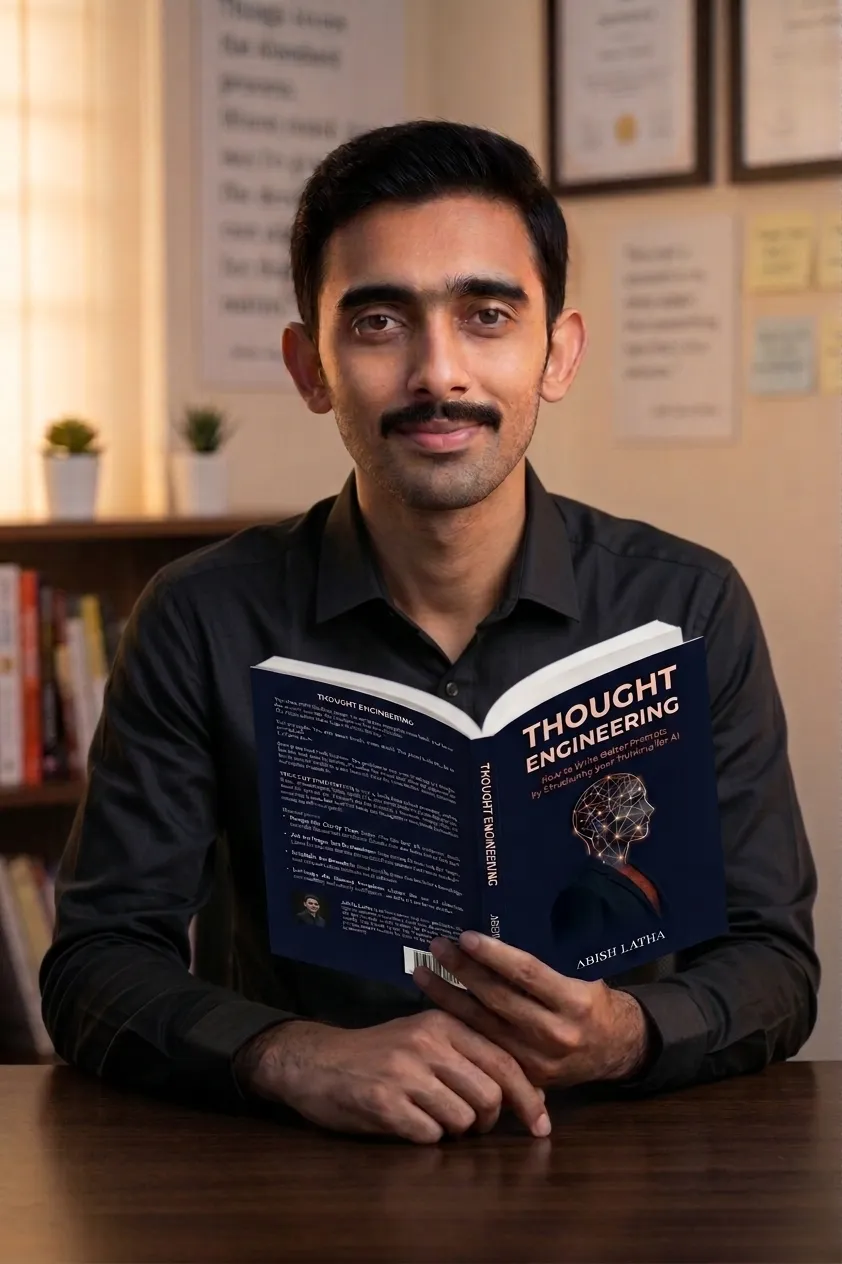
Abish Latha is a bio-curator by trade - an architect of information who builds knowledge graphs and data models that help complex biological systems talk to each other. Structure and precision aren't a hobby for him; they're the job.
When generative AI arrived, he didn't chase trends or collect "magic prompts" from the internet. He applied the same structured, testable rigor he uses daily: deliberately testing, breaking, and rebuilding prompts by the hundreds to isolate exactly what made them succeed or fail.
What he found, and what Thought Engineering proves chapter by chapter, is that prompting was never a technical trick — it's the articulation of clear human logic. The book is the resulting system: a field guide written by someone who navigated the chaos so readers don't have to repeat the same hundreds of failed attempts.

Abish Latha
--- GET THE BOOK
Not a prompt list.
A thinking system that doesn't expire.
Written for professionals, knowledge workers, students, and anyone who's ever closed a chat window in frustration. Available in paperback and digital editions across all major self-publishing platforms.
Format
Paperback; eBook (PDF & EPUB)
Language
English
Category
Artificial Intelligence/ Skill/ Self-Help
Inside, you'll learn how to:
Kill the three myths about what AI actually is, so you stop expecting magic it was never built to give
Use the Clarity Principle and the Blueprint to get a usable result on your first real attempt
Diagnose exactly why a response failed and fix it in one move, instead of guessing
Break down overwhelming projects with the Split & Sequence strategy
Control tone and voice with the Persona Paradox, without falling into its trap
Catch confidently wrong AI output before it reaches real work, using verification habits from The Sentinel
Build repeatable systems instead of reinventing your approach every time
Protect the one thing AI cannot replace — Your Judgment
Book Available now at:
Before buying the book, read the first chapter of THOUGHT ENGINEERING and learn:
Why your prompts fail even when your question is perfectly clear — and the one-sentence fix
The 3 myths about AI that quietly wreck your results (most people believe all three)
A real before/after prompt rewrite you can copy and use today
--- FREQUENTLY ASKED QUESTIONS
Every question, answered up front
If you're still deciding, this section is built to answer it — no need to message before you buy.
It's a non-technical guide that teaches the thinking system behind effective AI prompts, rather than a list of copy-paste phrases. You'll learn to structure your own thinking clearly enough that any AI (current or future) can understand and act on it.
Professionals, knowledge workers, students, founders, and everyday AI users who are tired of vague, generic answers and want a durable skill instead of prompts that expire with the next model update.
No. The book is written in plain language for general readers. There's no code, no math, and no assumption of prior AI experience.
Most competing books teach specific phrases and templates that stop working the moment a model updates. Thought Engineering teaches the underlying thinking architecture, so the skill keeps working no matter which AI tool you use next, this year or in five years.
Abish Latha is a professional bio-curator who builds knowledge graphs and data models for a living - structure and precision are literally his job. He applied that same rigor to AI prompting, testing and breaking hundreds of prompts on purpose before writing a single chapter, rather than approaching it as a trend or a marketing angle.
No. That's the entire point of the book. Because it teaches a thinking framework rather than model-specific phrases or tricks, the core system continues to apply regardless of which AI tool or model version you're using.
The book is available on Amazon (Kindle Direct Publishing), Notion Press, Pothi.com, and Namya Press, in both paperback and digital formats. Use the links in the "Get the Book" section above.
Both. Each retail platform above offers a digital edition alongside the 6×9 paperback.
144 pages, organized into five parts (The Foundation, The Control Loop, The Strategist, The Specialist, and The Architect) plus two appendices (a prompting cheat sheet mapped to real-world scenarios, and a glossary) - so it works as both a full read and a permanent desk reference.
Both work. The five parts build on each other for a first read, but each chapter and the appendix cheat sheet are designed to stand alone once you've read Part I, so you can return to the exact section you need later.
All of them. The book intentionally avoids teaching tool-specific tricks. Because it focuses on how you structure your own thinking, the frameworks apply equally to any text, image, or voice-based AI tool, including ones that don't exist yet.
Use the contact details in the footer below, or reach out through the author's social channels listed there.
Stop Prompting.
Start Thinking.
The AI skill that never goes obsolete. Get your copy today.